How to Choose a Private Label Gummy Manufacturer comes down to four things: manufacturing standards, testing protocols, formulation capabilities, and order logistics. A private label gummies manufacturer that scores well on all four gives a brand a real shot at launching dietary supplement gummies that taste good, hold their shape, and match the label. Missing any one of them usually shows up later as melted batches, failed potency results, or blown launch dates.
What Separates a Solid Gummy Partner from a Risky One?
Production Capabilities and Custom Formulations
The first fork in the road is stock formula gummies versus a custom gummy formulation. Stock formulas are pre-developed recipes that ship faster and cost less to start, but the same base may sit on a competitor's shelf. A custom gummy formulation takes longer, though it allows unique active blends, dosing, and flavor profiles.
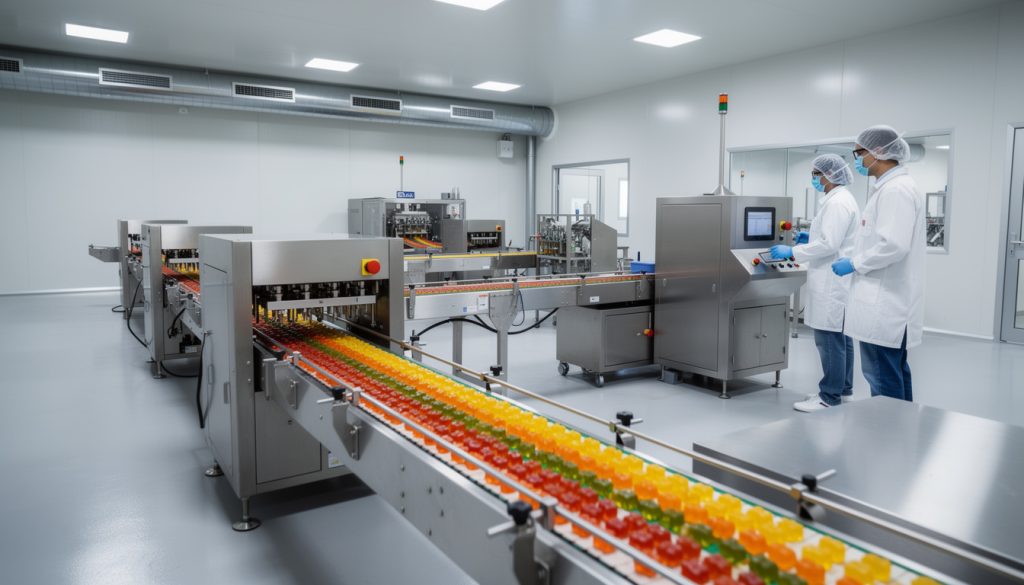
Either way, the ingredient portfolio matters. Some actives taste bitter, chalky, or metallic, so flavor masking is a skill that separates strong gummy contract manufacturing from average. Equipment plays a part as well. Depositing systems, starchless molds, and cooling tunnels influence texture, shape consistency, and how evenly actives spread through each piece.
Capacity, MOQ, and Production Timelines
MOQ (minimum order quantity) varies widely. Smaller private label gummies runs may start at a few thousand units, while custom work often requires more. The figure is worth comparing against a brand's real sales forecast, not a hopeful one.
Lead time also splits into stages. Formulation trials take the longest, reorders move faster, and commercial-scale runs depend on how full the production calendar is. Partners that answer emails quickly, explain delays plainly, and bend on scheduling when needed cut out much of the supply chain friction.
Scenario: A Facility Claims GMP, but the Paperwork Is Thin
"We follow GMP" is easy to say. A verified cGMP compliant facility can back it up with documents. Real GMP manufacturing leaves a paper trail: audit reports, inspection summaries, corrective action records, and written standard operating procedures that staff actually follow. Third-party programs such as NSF GMP certification assess facilities against recognized benchmarks and check documentation, facility controls, and allergen handling.
Beyond the certificate, two systems deserve a closer look. An allergen control program should spell out line cleaning, scheduling of allergen-containing products, and verification swabs, because blending several active ingredients in shared equipment is where cross-contact happens. Ingredient traceability is the second. Every raw material lot should be traceable from intake through blending to the finished batch, so a supplier problem can be isolated in hours instead of weeks.
Testing Metrics That Prove a Gummy Holds Up
Every production batch should arrive with a certificate of analysis (COA). A COA lists what was tested, the method used, and the result against spec. A COA with missing parameters or no lab name is a red flag.
The standard third-party lab testing battery covers microbial testing for pathogens, yeast, and mold, plus heavy metals testing for lead, arsenic, cadmium, and mercury. Reference frameworks like the microbiological criteria guidance from the World Health Organization offer background on how microbial limits are set. Potency testing, usually done by chromatography-based methods, confirms that vitamins and botanicals match the label claim and have not degraded after cooking and depositing.
Stability is the other half. A formal shelf-life study, backed by real-time stability testing under shifting temperature and humidity, shows whether a gummy survives its stated shelf life. Typical flaws include melting, sweating, sticking, and clumping, and most trace back to poorly controlled water activity. Packaging matters here too: packaging options (bottles, pouches) with desiccant seals protect texture and potency in transit.
Pectin vs Gelatin: Side-by-Side
The gelling base shapes almost everything about dietary supplement gummies, from the bite to who can eat them. Pectin, extracted from citrus, suits vegan, vegetarian, and kosher positioning. It tolerates heat better, so a pallet sitting in a warm truck is less likely to fuse. It sets quickly and gives a cleaner, shorter bite.
| Factor | Pectin | Gelatin |
|---|---|---|
| Source | Citrus or apple, plant-based | Animal-derived |
| Dietary fit | Vegan, vegetarian, kosher-friendly | Limited by animal origin |
| Texture | Clean bite, lower chew resistance | Elastic, classic chew |
| Heat tolerance | Higher melting point | Melts or clumps at lower temperatures |
| Setting time | Faster | Slower |
| Active compatibility | Handles acidic actives with pH adjustment | High-acid actives or minerals can weaken the gel network |
Gelatin still has a loyal following for its stretchy, traditional mouthfeel. The trade-off is thermal sensitivity and fussier chemistry. For a custom gummy formulation built around acidic or mineral-heavy actives, the base choice should be settled early with the formulator, since it affects the whole range of private label gummies a brand might plan.
Where Quotes Diverge: Pricing Drivers and Surprise Fees
Active Ingredients, Sweeteners, and Flavor Systems
Base pricing follows the actives. Branded raw components and specialized botanical extracts cost far more than commodity vitamins. Sweeteners add another layer: conventional sugar bases are cheapest, while sugar-free options such as maltitol, allulose, or stevia blends raise costs and change texture. Flavor and color work the same way. Custom natural flavors, organic fruit concentrates, and plant-derived colors cost more than synthetic equivalents, which explains much of the gap between two quotes for what looks like the same product.
Packaging, Label Compliance, and Hidden Surcharges
Packaging adds up quickly. Child-resistant caps, custom induction seals, and serialized barrier pouches all carry their own price tags. After production come the costs that rarely appear in the first quote: full-panel third-party lab testing fees, warehousing charges, and palletization specifications. A private label gummies manufacturer that itemizes these upfront makes quotes easier to compare, and it also makes lead time easier to predict, since packaging components often arrive on their own schedule.
You can explore the services through the website at the attached link: maya-plus.com.
Common Mistakes Before Signing a Manufacturing Agreement
The biggest mistake is assuming the contract covers what the sales conversation implied. Several questions are worth settling in writing with any gummy contract manufacturing partner. Who owns regulatory label review? What potency overage is acceptable, and what stability is guaranteed through the target shelf life? What happens when a batch fails: rejection rules, remediation steps, and who absorbs the cost? Change control matters too, since a switched raw material source should trigger notification before it affects the product.

Logistics deserve equal attention. Contracts should address production scheduling, repeat order turnaround, and buffer inventory of raw materials. Batch yield discrepancies need defined tolerances, and freight staging needs storage conditions that protect finished goods. Final QC sign-off should be a named milestone, with the certificate of analysis (COA) released before shipment. Finally, the MOQ (minimum order quantity) should be checked for reorders, not just the first run, because a low entry threshold followed by a much higher reorder minimum is a familiar trap with any private label gummies manufacturer.
Is pectin always better than gelatin for gummies?
Not always. Pectin suits plant-based positioning and warm shipping routes, while gelatin delivers the traditional chewy texture. The better choice depends on the target customer and the actives in the formula.
What documents prove a facility is genuinely GMP compliant?
Third-party audit reports, certification records, inspection summaries, and written standard operating procedures give the clearest evidence. A verbal claim or a logo on a website does not.
Why does water activity matter in gummies?
Water activity influences microbial growth and physical stability. When it is poorly controlled, gummies can sweat, stick together, or harden, and shelf life suffers.
Are stock formula gummies a bad option?
They are not. Stock formulas offer faster launches and lower entry costs. The drawback is limited differentiation, since similar bases may appear in other brands.
About the Business
Maya Plus is a leading manufacturer of high-quality food supplement and vitamin gummies. The company offers private label solutions tailored to the needs of health-conscious consumers, retailers, and businesses. Its work centers on innovative gummy formulations for men, women, kids, sports nutrition, and beauty applications.